
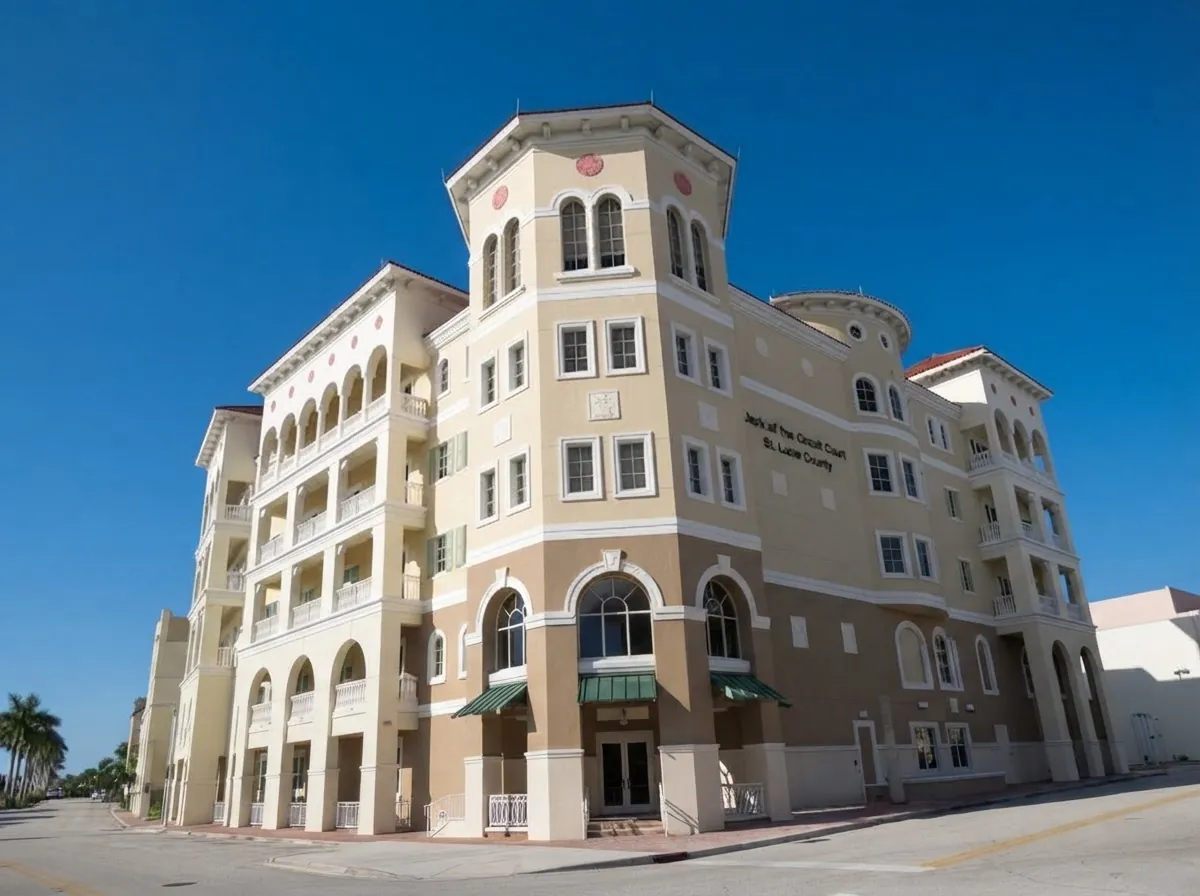
Court records of St. Lucie County, Florida, are maintained by the Clerk of the Circuit Court and Comptroller and are accessible through online tools, official court portals, and directly at the clerk's office. StLucieCourt.us will help find public information about the county's court records. Additionally, you can use the public search on the clerk's website, the Florida state court portal, and other government resources to obtain documents and check cases.
St. Lucie Court System Overview
St. Lucie County is part of the 19th Judicial Circuit of Florida, which also includes Indian River, Martin, and Okeechobee counties. The Circuit Court handles serious criminal and civil cases, while the County Court deals with less serious offenses, traffic violations, and small claims. The Chief Judge of the 19th Judicial Circuit administers all courts in the county. The main courthouse is located in Fort Pierce.
Courts Serving St. Lucie
Residents of the county are served by several courts at the state and federal levels.
State Courts
Federal Courts
Bankruptcy cases are handled by the U.S. Bankruptcy Court, Southern District of Florida, with the main office in West Palm Beach. There are no municipal courts in St. Lucie County — all local cases go to the County Court.
What Types of Cases St. Lucie Courts Hear
The county courts handle a wide range of cases. Here are the main categories:
- Felonies and misdemeanors
- Traffic violations and DUI
- Civil claims (large and small)
- Family law: divorce, child custody, alimony
- Probate and guardianship
- Juvenile and child protection cases
- Adoption
Each category has its own procedure, detailed below.
District Court Cases in St. Lucie
The Circuit Court in St. Lucie handles cases beyond the jurisdiction of the County Court. This includes all felony cases after preliminary hearings, civil claims over $50,000, appeals from the County Court, as well as probate, guardianship, and family law cases. Cases are assigned to circuit court judges according to specialization — criminal, civil, or family division. The Criminal Division of the Clerk maintains records of all felony cases. After a verdict or decision, parties may appeal to the Fourth District Court of Appeal.
Magistrate Court Cases in St. Lucie
The County Court is the court of first instance for less serious cases. It handles misdemeanors, traffic violations, DUI cases, and civil claims up to $50,000 under Florida law. Small claims are limited to $8,000. Preliminary hearings in felony cases also start here before being transferred to the Circuit Court.
County Court judges are often assigned specific categories of cases — for example, a judge may exclusively handle traffic cases or DUI hearings due to the high volume of such cases in the county.
Family Law, Probate, and Juvenile Matters in St. Lucie
Family Law. Divorce, custody, alimony, paternity, and protective orders are handled by the family division of the Circuit Court. Petition forms for dissolution of marriage are available for free on the Florida Courts website, and information on filing documents in St. Lucie can be found on the clerk's divorce page. A divorce certificate can be ordered through the Florida Department of Health.
Probate and Guardianship. Probate is the court process of administering a deceased person's estate. These cases, along with guardianship (for incapacitated individuals), are handled by the Circuit Court. Documents are filed through the electronic portal or directly at the clerk's office.
Juvenile Matters. The Juvenile Court handles juvenile offenses and child protection cases. Records in such cases are confidential under Florida law and are not available through public search.
How Cases Move Through the St. Lucie Court System
- Filing a Case. A criminal case begins with an arrest affidavit or information, a civil case with a complaint, and a family case with a petition. Documents are filed through the Florida Courts E-Filing portal or in person.
- Judge Assignment. The clerk registers the case and assigns it to a specific judge according to the category.
- First Hearing. In criminal cases, this is the arraignment. In civil cases, it's a case management conference.
- Pre-Trial Phase. Parties exchange evidence (discovery), file motions, and in criminal cases, plea negotiations may occur.
- Trial or Resolution. The case concludes with a sentence, settlement, default judgment, or jury verdict.
- Post-Judgment. Sentencing, appeal filing, or enforcement of judgment.
Court Administration, Local Rules, and Public Access in St. Lucie
The administration of the courts of the 19th Judicial Circuit is carried out by the Chief Judge with the support of the Trial Court Administrator. Local rules of the judicial circuit are published on the official Florida Courts website.
According to the Florida Public Records Act (Chapter 119, Florida Statutes), most court records are public. However, some categories — including juvenile cases, sealed or expunged records, and certain family cases — have restricted access. Viewing confidential materials requires registration according to the Court Records and Access Security Matrix.
Hearings can be attended in person at the courthouse. Some sessions are held remotely — check the format through the daily court schedule on the clerk's website. For public records requests, contact the clerk's office, which is the official custodian of public records according to FS 119.12(2).
Court Records and Related Court Resources in St. Lucie
- Court Case Search. Court Case Search on the clerk's website allows searching for cases by party name or case number. Registered users have access to enhanced results.
- Official Records. Documents on real estate, mortgages, liens, and other public records are available through the Official Records Search.
- Appellate Cases. Decisions and documents of Florida appellate courts can be found through the Florida Appellate Case Information System.
- Court Forms and Self-Help. Free forms for family, civil, and other cases are available on the Florida Courts Help portal.
- Inmate Information. Inmate Lookup on the county sheriff's website shows current inmates and those released within the last five days.
- Arrest Information. Daily arrest data is published on the Daily Arrest Information page of the sheriff's office.
- Wanted Persons. The FDLE database contains information on arrest warrants throughout Florida — use the Wanted Persons Search.
- Florida County Jails. The State Department Directory contains contacts and links for inmate searches in each county.
- Property Appraisal. The St. Lucie County Property Appraiser provides property appraisal data, and public records requests can be submitted through the dedicated page.
- Department of Health. The Florida Department of Health in St. Lucie County provides services for issuing birth, death, and other vital records.